Jobanchorpoint
How Long Does It Take to Become a Veterinary Technician?
Most credentialed techs finish an accredited two-year program, pass the VTNE and apply to their state board — here is how those stages stack up.
By James O'Connor · Published · Updated · 13 min read
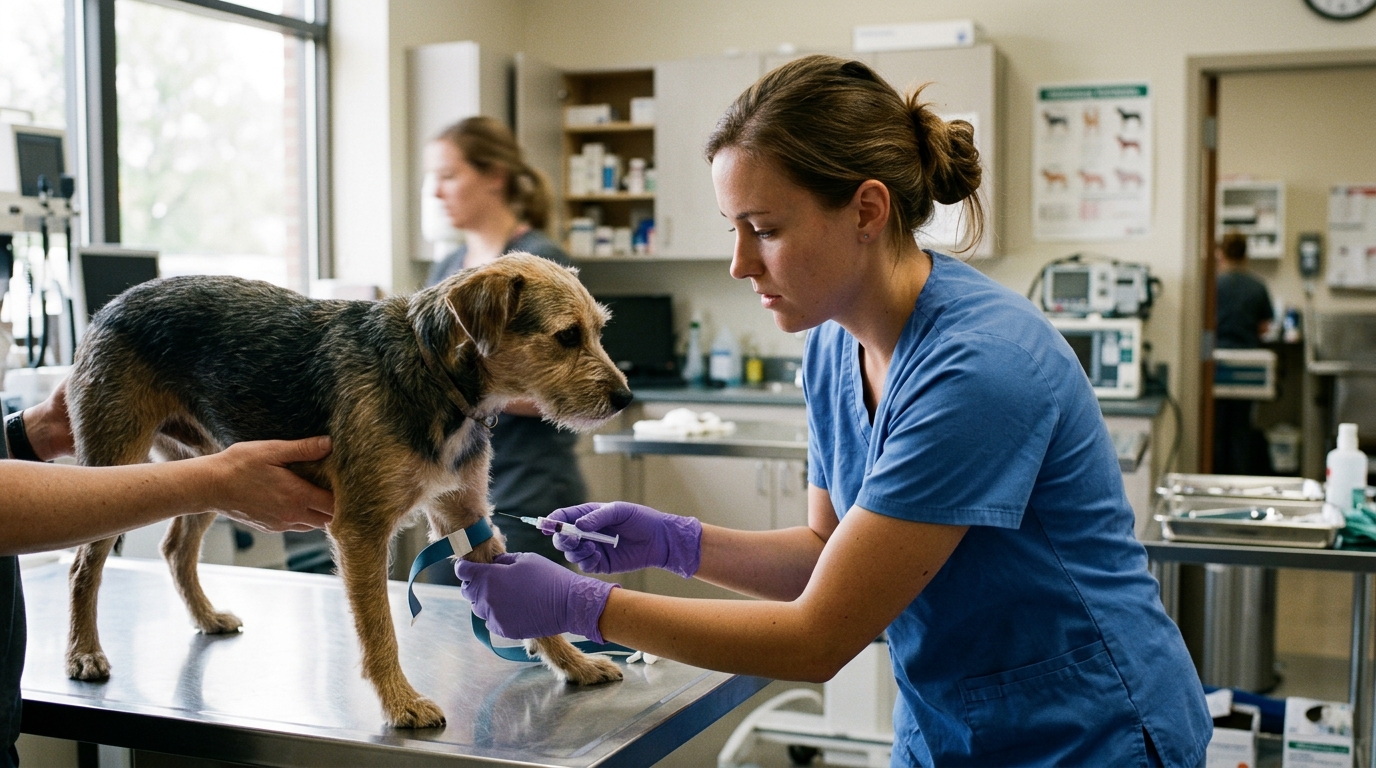
For most people it takes about two to three years: a two-year associate's degree in veterinary technology, then a credentialing exam and a state application that together usually add a few weeks to a few months. Veterinary technicians usually need a 2-year associate's degree, while veterinary technologists usually need a 4-year bachelor's degree in veterinary technology (U.S. Bureau of Labor Statistics, 2025).
The spread comes from how you study. Full-time, on-campus students finish fastest; part-time and distance students working in a clinic often take three to four years, and your state's processing time for a licence, registration or certificate sits on top of that.
What a Veterinary Technician does
A veterinary technician is the nurse, anesthetist, radiographer and lab tech of a veterinary practice. You do not diagnose or prescribe — a veterinarian does that — but almost everything else that touches the patient passes through your hands.
A typical day includes:
- Observing animal behaviour and condition, and collecting case histories from owners before the veterinarian comes in (U.S. Bureau of Labor Statistics, 2025).
- Providing nursing care and emergency first aid to sick, injured or recovering patients (U.S. Bureau of Labor Statistics, 2025).
- Administering anesthesia and monitoring the patient's response through surgery, plus preparing animals and instruments for the procedure (U.S. Bureau of Labor Statistics, 2025).
- Taking diagnostic radiographs and positioning patients safely for them (U.S. Bureau of Labor Statistics, 2025).
- Running in-house lab work such as urinalyses and blood counts (U.S. Bureau of Labor Statistics, 2025).
- Administering medications and vaccines on the veterinarian's orders (U.S. Bureau of Labor Statistics, 2025).
- Restraining animals during exams, performing dental cleanings and extractions, placing catheters, and assisting with euthanasia (O*NET OnLine, 2026).
Where you work. Most roles are in private clinics and animal hospitals, and technicians also work in laboratories, colleges and universities, and humane societies (U.S. Bureau of Labor Statistics, 2025). Equine and food-animal practices add driving between farms.
The schedule. General practice often runs on weekday daytime shifts with a rota of Saturdays. Emergency and 24-hour hospitals run overnights and holidays. Expect to work evenings, weekends or holidays in many roles (U.S. Bureau of Labor Statistics, 2025).
The honest downside. This is physical work — lifting, restraint, bites and scratches, hours on your feet, radiation safety protocols, exposure to anesthetic gases and zoonotic disease. It is also emotional work: you will assist with euthanasia regularly and manage owners who cannot afford the care their animal needs. Compassion fatigue and burnout are common reasons people leave, and the pay relative to the responsibility is a frequent complaint in the field. Talk to a working technician about this before you enrol, not after.
How to become one
- Finish high school or a GED and arrange a day shadowing a credentialed technician. Ask the practice manager at a local small-animal hospital for half a day in the treatment area, and a second day at an emergency or shelter practice if you can. Time: a week or two to arrange, one to three days to do. Cost: none. A high school diploma is the baseline educational requirement before an accredited program (Penn Foster, undated).
- Look up your own state's rules before you pick a program. Credentialing is regulated state by state and most states require you to pass an exam (U.S. Bureau of Labor Statistics, 2025); the CareerOneStop certification finder is the signposted place to check what your state requires (U.S. Bureau of Labor Statistics, 2025). The titles CVT, LVT and RVT vary by state but describe the same credentialed status, and the current term recognised by both NAVTA and the AVMA is "Veterinary Technician" (NAVTA, undated). Time: one or two hours.
- Enrol in a program accredited by the AVMA's Committee on Veterinary Technician Education and Activities (CVTEA). More than 200 programs are CVTEA-accredited, and most offer a 2-year associate's degree while others offer a 4-year bachelor's degree (American Veterinary Medical Association, undated; U.S. Bureau of Labor Statistics, 2025). Time: about two years full-time for an associate's, three to four part-time, four years for a bachelor's. Cost: varies enormously between a community college and a private or distance program — ask the admissions office for the current per-credit tuition plus fees for scrubs, lab packs and liability insurance, and ask about in-state versus out-of-state rates.
- Complete the externship and log your essential skills. CVTEA requires graduates to be deemed competent in over 300 essential skills (American Veterinary Medical Association, undated), and an externship in a working practice is part of the standard path (Penn Foster, undated). Keep your skills log current — unsigned skills are the single most common reason students graduate late. Time: typically a term's worth of placement hours, often several hundred.
- Apply to the American Association of Veterinary State Boards (AAVSB) to sit the VTNE. You must be a graduate of an AVMA- or CVMA-accredited program, or of a program approved by your jurisdiction's board, and submit an application to the AAVSB (VetTechPrep citing the AAVSB Candidate Information Handbook, undated). There are three pathways — Accredited, On-the-Job Training, and Alternate — and most jurisdictions require graduation from an accredited program (AAVSB, undated). Time: allow several weeks between applying and your testing window. Cost: check the AAVSB's current published exam fee; your state board may charge separately.
- Sit the VTNE. It is a three-hour, computer-based exam of 170 multiple-choice questions — 150 scored and 20 unscored pilot items — administered through PSI either in person or by live remote proctoring (AAVSB, undated). Study time: most candidates give it six to ten weeks alongside the end of their program, using a question bank and their pharmacology and anesthesia notes.
- Submit your state licence, registration or certification application. A passing VTNE score plus an approved application is what turns you into an LVT, RVT or CVT (Penn Foster, undated). Time: weeks to a few months depending on the board's queue, background check and transcript verification. Cost: a state application fee — check your board's current schedule.
- Apply for your first role and keep your continuing education current. Build a one-page skills summary that names what you can do unsupervised — IV catheter placement, dental prophylaxis, anesthetic induction and monitoring, digital radiography positioning — and ask your externship supervisor for a reference. Credentialed status is maintained with ongoing continuing education credits (Penn Foster, undated). Time: applications typically take four to twelve weeks to turn into an offer.
Skills you'll need
Hard skills
- Anesthesia and patient monitoring. Calculating drug doses, inducing and maintaining anesthesia, and reading a multiparameter monitor — ECG, capnography, pulse oximetry, blood pressure — while the surgeon works. Administering anesthesia and monitoring the animal's response is a core listed duty (U.S. Bureau of Labor Statistics, 2025).
- Diagnostic imaging. Positioning for digital radiography, using the generator settings correctly, and following dosimetry and lead-shielding protocols. Assisting with ultrasound is common in general practice.
- In-house laboratory work. Running urinalyses, complete blood counts and chemistry panels on bench analysers, plus blood smears, fecal floats and cytology under a microscope (U.S. Bureau of Labor Statistics, 2025).
- Venipuncture, IV catheters and dentistry. Blood draws, catheter placement, enemas and catheterizations, and dental scaling, polishing and extraction assistance with an ultrasonic scaler and dental radiography unit (O*NET OnLine, 2026).
- Practice management software and medical records. Charting treatments, controlled-drug logs and anesthetic records accurately in the clinic's practice information management system. Sloppy records are a licensing risk, not just an annoyance.
- Restraint and low-stress handling. Safe restraint of dogs, cats, exotics and — depending on practice type — horses and livestock (O*NET OnLine, 2026).
Soft skills
- Client communication. Show it by taking a full case history from an anxious owner and relaying it to the veterinarian in a structured, factual handover; practise this during your externship and ask for feedback.
- Composure under pressure. Show it with an example in interviews: the crashing patient you triaged, what you did first, and what you handed off. Name the steps, not the drama.
- Attention to detail. Show it through your drug calculations and your anesthetic record — ask a mentor to audit a week of your charts and tell you what they would have written differently.
- Teamwork and handover discipline. Show it by describing how you hand a hospitalised patient to the next shift: fluid rates, last medication times, outstanding orders.
- Emotional resilience. Show it by naming what you actually do after a hard euthanasia shift — debrief with a colleague, use the practice's support resources — rather than claiming it does not affect you.
Pay and outlook
The median annual wage for veterinary technologists and technicians was $47,380 in May 2025 (U.S. Bureau of Labor Statistics, 2025). That is a midpoint across the whole occupation, and what you are offered will sit above or below it for reasons you can partly control.
The main drivers are:
- State and local market. Credentialing rules, cost of living and practice density differ sharply between states, and so do wages. A metro emergency hospital and a rural mixed practice in the same state may be nothing alike.
- Credential status. Being a licensed, registered or certified technician rather than an uncredentialed assistant is usually what unlocks the higher band, because it changes what you are legally allowed to do unsupervised.
- Practice type. Emergency and critical care, specialty referral hospitals, research laboratories and university teaching hospitals tend to pay differently from general small-animal practice, and often come with shift differentials for overnights, weekends and holidays.
- Specialty credentials and seniority. A recognised veterinary technician specialty, or a lead/supervisory role, changes your bargaining position.
- Benefits. Compare the whole package: continuing education allowance, licence renewal fees, scrubs, pet care discounts, retirement contributions and whether overtime is paid.
On demand: veterinary technologists and technicians held about 131,400 jobs in 2025, employment is projected to grow 9 percent from 2025 to 2035 — much faster than the average for all occupations — and about 13,400 openings are projected each year on average over the decade (U.S. Bureau of Labor Statistics, 2025). Many of those openings come from people leaving the occupation, which is consistent with what practices report about turnover.
Check current numbers yourself rather than trusting any page's snapshot. The BLS Occupational Outlook Handbook entry for veterinary technologists and technicians is the official national source, and it carries state and metro wage detail. For state-by-state credentialing requirements, CareerOneStop is the signposted place to look (U.S. Bureau of Labor Statistics, 2025).
Career path
| Stage | Typical titles | Usual time at this stage |
|---|---|---|
| Pre-entry | Veterinary assistant, kennel technician, shelter caretaker | 0–2 years, often alongside study |
| Entry | Credentialed veterinary technician (CVT, LVT or RVT depending on state) | 1–3 years |
| Mid | Lead technician, surgery or anesthesia technician, emergency/ICU technician, research animal technician | 3–7 years |
| Senior | Head technician, practice or hospital manager, veterinary technician specialist (VTS), program instructor, industry or pharmaceutical technical role | 7+ years |
Entry (years 0–3). You start as a newly credentialed technician in general practice or a busy emergency hospital. The first year is about speed and confidence: placing catheters first time, running anesthesia on routine cases, handling a full appointment schedule. Expect close supervision at first.
Mid (years 3–7). You take on a focus. That might be surgery and anesthesia, dentistry, emergency and critical care, exotics, or laboratory animal work. Many technicians become the person who trains assistants and new graduates, which is the usual first step toward lead technician.
Senior (years 7+). Two broad routes. The management route — head technician, then practice manager — trades clinical hours for rotas, budgets, inventory and hiring. The clinical specialist route goes through a recognised academy: NAVTA established the Committee on Veterinary Technician Specialties in 1994 to recognise credentialing academies for technician specialties, and candidates must typically already be credentialed as an RVT, CVT or LVT to qualify for a specialty exam (VetTechColleges.com, undated). Specialty candidacy usually means documented case logs and hours in that discipline over several years, so plan it from your mid-career job choices.
Sideways moves are common and worth knowing about: teaching in a veterinary technology program, technical support or field roles with diagnostics and pharmaceutical companies, laboratory animal medicine at a university, and shelter medicine. Technologists with a 4-year bachelor's degree in veterinary technology (U.S. Bureau of Labor Statistics, 2025) often find research and academic routes easier to enter.
Frequently asked questions
Do I need a degree to become a veterinary technician?
In practice, yes. Veterinary technicians usually need a 2-year associate's degree and technologists usually need a 4-year bachelor's degree in veterinary technology (U.S. Bureau of Labor Statistics, 2025), and most jurisdictions require graduation from an AVMA-CVTEA or CVMA-accredited program to sit the credentialing exam (AAVSB, undated). There are three VTNE pathways — Accredited, On-the-Job Training, and Alternate — but the OJT and Alternate routes are only available where a jurisdiction allows them (AAVSB, undated), so check your state board before counting on one. You can work as an uncredentialed veterinary assistant without a degree, but the tasks you are permitted to perform are narrower.
How long does it take if I study part-time while working in a clinic?
Usually three to four years rather than two. Distance and part-time CVTEA-accredited programs are built for people already working in practice, but they still require the same clinical competencies — graduates must be deemed competent in over 300 essential skills (American Veterinary Medical Association, undated) — and those skills have to be signed off by a qualified mentor at an approved site. Finding and keeping that mentor is the usual bottleneck. Add several weeks for the AAVSB application and testing window, plus however long your state board takes to process the credential.
Can any of this job be done remotely?
The clinical work cannot. Anesthesia, radiographs, catheters, dentistry and nursing care all happen with the patient in front of you, and most roles are in private clinics and animal hospitals (U.S. Bureau of Labor Statistics, 2025). Some adjacent roles use the credential off the floor — telehealth triage and client support, technical support for diagnostics or pharmaceutical companies, teaching in a distance veterinary technology program, insurance claims review — but they generally expect clinical experience first. The coursework itself can be remote: accredited programs exist in distance format, with in-person clinical placements. The exam can be taken in person or by live remote proctoring through PSI (AAVSB, undated).
What is the VTNE and how hard is it to schedule?
The Veterinary Technician National Examination is a three-hour, computer-based exam of 170 multiple-choice questions, of which 150 are scored and 20 are unscored pilot items. It is owned and administered by the American Association of Veterinary State Boards and delivered through PSI, in person or by live remote proctoring (AAVSB, undated). You apply to the AAVSB and test within a defined window, so build in several weeks between application and sitting. Most candidates study for six to ten weeks using a question bank alongside their final term.
Does the credential transfer if I move to another state?
Not automatically. Each state regulates veterinary technologists and technicians differently, though most require an exam (U.S. Bureau of Labor Statistics, 2025), and the title itself changes — CVT, LVT and RVT vary by state but refer to the same credentialed status (NAVTA, undated). A passing VTNE score generally travels better than the credential does, because the new board will still want its own application, fees and continuing education evidence. Check the destination state's board and the CareerOneStop certification finder before you move, and keep copies of your transcripts, score report and CE records.
Sources
- U.S. Bureau of Labor Statistics — Veterinary Technologists and Technicians : Occupational Outlook Handbook (2025)
- U.S. Bureau of Labor Statistics — Veterinary Technologists and Technicians : Occupational Outlook Handbook (print/cache version) (2025)