Jobanchorpoint
How Long Does It Take to Become a Plumber?
The route runs through a paid apprenticeship, a state licensing exam and thousands of logged hours — here is what each stage asks of you.
By Theo Lindqvist · Published · Updated · 13 min read
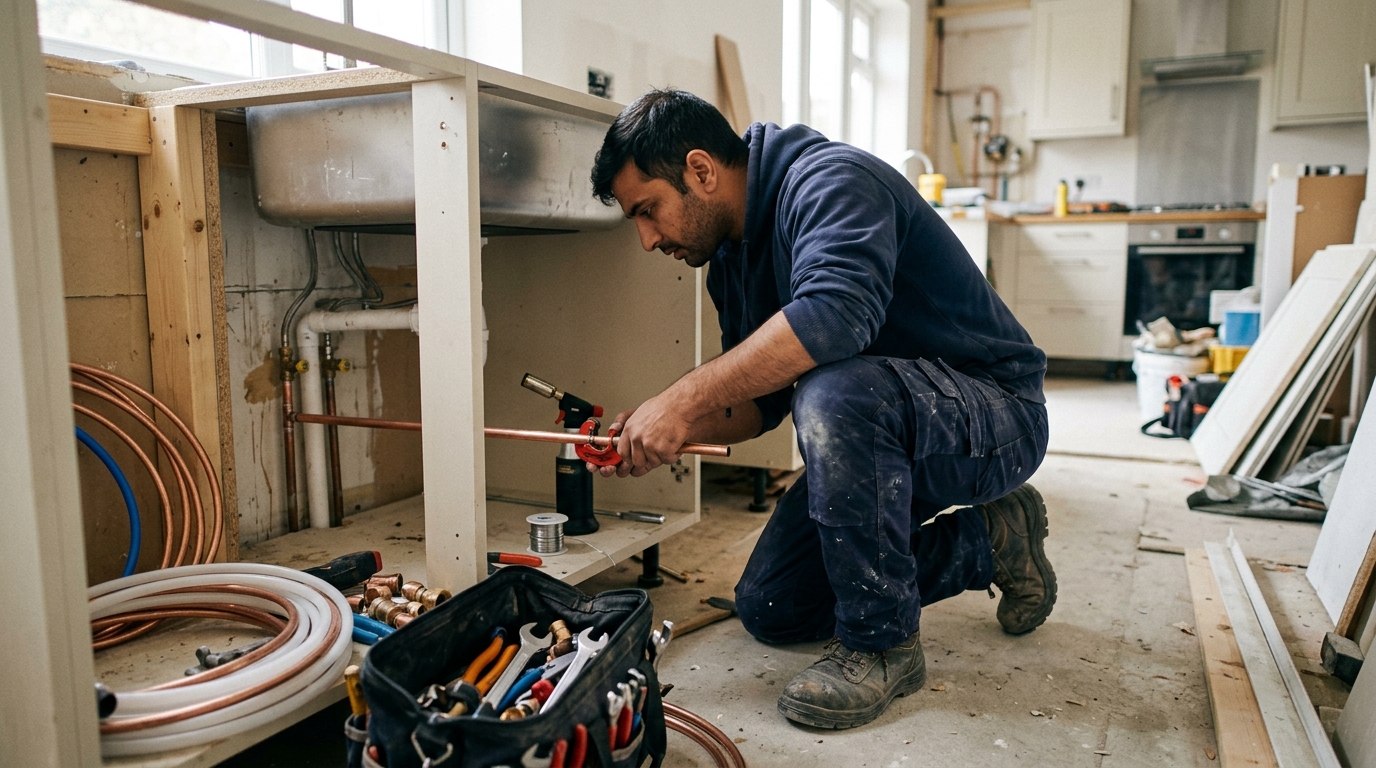
Most plumbers reach journey level in four to five years. That is how long a typical apprenticeship runs, with about 2,000 hours of paid on-the-job training plus technical instruction each year (U.S. Bureau of Labor Statistics, 2026-08-27). You start earning from the first year, not after it.
The variable part is licensing. Most states and some localities require a license, and that often means 2 to 5 years of documented experience and passing an exam before you can work independently (U.S. Bureau of Labor Statistics, 2026-08-27) — so your state board, not a school, sets your real finish line.
What a plumber does
Plumbers, pipefitters and steamfitters install and repair piping fixtures and systems (U.S. Bureau of Labor Statistics, 2026-08-27). On a given day that looks like this:
- Read blueprints and system diagrams to work out where pipe runs, drains and vents go. Many diagrams are now created digitally with Building Information Modeling (BIM), which lets trades collaborate on planning a building's physical systems (U.S. Bureau of Labor Statistics, 2026-08-27).
- Determine the materials and quantities a job needs, and prepare cost estimates for the customer or the general contractor (U.S. Bureau of Labor Statistics, 2026-08-27).
- Cut, join and install pipe and fixtures using drills, saws, welding torches and press fitting tools (U.S. Bureau of Labor Statistics, 2026-08-27).
- Inspect and test systems — pressure tests on new runs, checking for leaks before walls close up.
- Troubleshoot faults: tracing a blockage, finding why a water heater short-cycles, working out whether a slow drain is a vent problem.
- Clear and repair drains and sewer lines with drain cleaning tools, including machine augers and camera work on buried lines.
- Maintain and repair existing plumbing systems on service calls, which is the bread and butter of residential work.
Where the work happens. In factories, homes, businesses and anywhere else there are pipes and related systems (U.S. Bureau of Labor Statistics, 2026-08-27). About 65 percent of people in this occupation work for plumbing, heating and air-conditioning contractors, and 8 percent are self-employed (U.S. Bureau of Labor Statistics, 2026-08-27). New construction and service work feel like different jobs: new construction is rough-in, repetition and schedule pressure; service is diagnosis, customer contact and driving between calls.
A typical schedule. Most plumbers work full time, including nights and weekends, and are often on call to handle emergencies; self-employed plumbers may set their own schedules (U.S. Bureau of Labor Statistics, 2026-08-27). A burst pipe does not wait for Monday. Expect an early start on construction sites, and expect your week to be interrupted if you carry the on-call phone.
The honest downside. The work is physical and the injuries are real: cuts from sharp tools, burns from hot pipes and soldering equipment, and falls from ladders are common on the job (U.S. Bureau of Labor Statistics, 2026-08-27). Add crawl spaces, attics in August, raw sewage on drain calls, and knees and shoulders that take a beating over a career. People leave the trade over the on-call hours more often than over the work itself.
How to become one
- Finish a high school diploma or equivalent. A diploma or equivalent is typically required to enter the trade (U.S. Bureau of Labor Statistics, 2026-08-27). If you are still in school, take algebra, geometry, physics and chemistry — apprentices study mathematics, applied physics and chemistry as part of technical instruction (U.S. Bureau of Labor Statistics, 2026-08-27). Time: as long as it takes to finish or to pass an equivalency test, commonly a few months of study for the latter.
- Get a driver's license and keep the record clean. Most employers require plumbers to have a driver's license (U.S. Bureau of Labor Statistics, 2026-08-27), because you are driving a van full of parts to the customer. Time: weeks. Cost: your state DMV's posted fee.
- Take vocational-technical courses in pipe system design, safety and tool use. Vocational-technical schools offer these, plus welding courses that some pipefitter and steamfitter apprenticeship programs require (U.S. Bureau of Labor Statistics, 2026-08-27). This is optional for plumbing but makes an application stronger. Time: a single course of a few weeks up to a two-year program. Cost: tuition varies widely by state and school — ask the admissions office for the published per-credit rate before you enrol.
- Talk to an apprenticeship coordinator. Contact the training coordinator at a local union apprenticeship program and the hiring manager at two or three plumbing, heating and air-conditioning contractors, since that is where most of the jobs are (U.S. Bureau of Labor Statistics, 2026-08-27). Ask when applications open, what the aptitude test covers, and whether they want a welding certificate. Time: a few weeks of calls. Cost: application fees where they apply.
- Complete a 4- or 5-year apprenticeship. Most plumbers learn the trade this way, typically with 2,000 hours of paid on-the-job training plus technical instruction each year (U.S. Bureau of Labor Statistics, 2026-08-27). The classroom side covers safety, local plumbing codes and regulations, and blueprint reading (U.S. Bureau of Labor Statistics, 2026-08-27). Time: 4 to 5 years. Cost: you are paid to train; some programs charge for books and tools.
- Log your hours in writing from week one. Keep a signed record of hours by category — service, rough-in, drain work — because your licensing board will ask for proof of experience. Time: ten minutes a week, for years. Losing this record is the single most common reason people stall before an exam.
- Pass the journey-level licensing exam. Plumbers complete an apprenticeship and pass the required licensing exam to become journey-level workers (U.S. Bureau of Labor Statistics, 2026-08-27). Most states and some localities require a license, and that often means 2 to 5 years of experience plus the exam before working independently (U.S. Bureau of Labor Statistics, 2026-08-27). Time: 1 to 3 months of code study. Cost: exam and license fees set by your state board — check their current fee schedule, not a third-party site.
- Build the kit and add an optional certification. Buy your own hand tools, a cordless drill, a press fitting tool and basic drain cleaning tools as you go rather than all at once (U.S. Bureau of Labor Statistics, 2026-08-27); costs run from a starter bag to several thousand dollars once powered tools are involved. Optional certification, such as in plumbing design, can broaden career opportunities (U.S. Bureau of Labor Statistics, 2026-08-27). Time: ongoing. Later, several years of experience plus another exam earns master status (U.S. Bureau of Labor Statistics, 2026-08-27).
Skills you'll need
Hard skills
- Joining pipe by several methods. Soldering and brazing with a welding torch, press fitting with a press tool, solvent welding plastics, and threaded connections. Employers test this; be ready to make a joint in front of someone.
- Reading blueprints and BIM models. Technical instruction in apprenticeships covers blueprint reading (U.S. Bureau of Labor Statistics, 2026-08-27), and many diagrams are now produced digitally with Building Information Modeling (U.S. Bureau of Labor Statistics, 2026-08-27). You need to find the isometric for a bathroom group without being walked to it.
- Working to local code. Apprentices study local plumbing codes and regulations (U.S. Bureau of Labor Statistics, 2026-08-27). Code differs by state and city, so what passes inspection in one jurisdiction fails in the next. Know which book your inspector uses.
- Drain and sewer diagnosis. Running a machine auger, a jetter and an inspection camera, and reading what the camera shows you.
- Estimating and material takeoffs. Preparing cost estimates and determining the materials a job needs are routine duties (U.S. Bureau of Labor Statistics, 2026-08-27). Practise by pricing a full fixture change-out before you quote one.
- Applied math and physics. Slope, pressure, flow and venting. Apprentices study mathematics, applied physics and chemistry for a reason (U.S. Bureau of Labor Statistics, 2026-08-27).
Soft skills
Important qualities for this occupation include communication skills, dexterity, mechanical skills, physical strength and troubleshooting skills (U.S. Bureau of Labor Statistics, 2026-08-27).
- Communication. Show it by explaining a repair to a homeowner in plain words and in writing — a short note on the invoice saying what failed and what you replaced. Supervisors notice who generates fewer callbacks and fewer complaints.
- Troubleshooting. Show it by describing a fault you chased to its actual cause in an interview, including the two things you ruled out first.
- Dexterity and mechanical sense. Show it with anything you have taken apart and reassembled — a motorcycle engine, a bike, a sink trap in your own house.
- Physical durability. Show it by turning up fit and by talking about how you protect your back and knees, not by boasting about lifting.
- Reliability under interruption. Show it by being honest about the on-call rota in the interview and saying you can do it. Nobody wants to train a plumber who vanishes at 5pm on a Friday.
Pay and outlook
The median annual wage for plumbers, pipefitters and steamfitters was $63,800 in May 2025, with the lowest 10 percent earning less than $44,150 and the highest 10 percent earning more than $108,420 (U.S. Bureau of Labor Statistics, May 2025). That spread is the useful part of the number: the gap between the bottom and the top of this trade is wide, and most of it is explained by a handful of things you can influence.
License level comes first. An apprentice is paid as an apprentice, usually on a step scale that rises as hours are logged; a journey-level license, which comes after the apprenticeship and the required exam (U.S. Bureau of Labor Statistics, 2026-08-27), moves you up; master status, earned with several years of experience and another exam (U.S. Bureau of Labor Statistics, 2026-08-27), is what lets you pull permits and supervise in many jurisdictions and is priced accordingly.
After that: hours. On-call, nights and weekends are common in this work (U.S. Bureau of Labor Statistics, 2026-08-27), and overtime and emergency call-out rates are a large part of what plumbers actually take home in a year. Specialty matters too — pipefitting, steamfitting, welding-heavy industrial work and medical gas work are priced differently from residential service. So does the setting: 65 percent of the occupation works for plumbing, heating and air-conditioning contractors and 8 percent are self-employed (U.S. Bureau of Labor Statistics, 2026-08-27), and self-employment trades a steady check for the chance to keep the margin, minus insurance, vehicles, bad debt and unpaid admin evenings. Region is the last big lever: cost of living, construction activity, union density and local licensing rules all vary by state and metro area.
On demand: the occupation held about 510,600 jobs in 2025, and employment is projected to grow 7 percent from 2025 to 2035, much faster than the average for all occupations, with about 42,000 openings projected each year on average (U.S. Bureau of Labor Statistics, 2026-08-27). Much of that opening count comes from replacing workers who retire or move on, which is the quiet reason trades keep hiring even in slow construction years. Residential service work also holds up better than new construction when building slows, because pipes fail regardless of the economy.
Check current figures yourself rather than trusting a jobs board average. The U.S. Bureau of Labor Statistics Occupational Outlook Handbook page for plumbers, pipefitters and steamfitters carries national and state wage data and the current projections, and your state licensing board publishes the license tiers and fees that sit behind the pay bands. For local rates, ask the apprenticeship coordinator at a union program in your area what the current wage steps are — they will tell you.
Career path
| Stage | Typical title | Years |
|---|---|---|
| Entry | Apprentice plumber (helper or pre-apprentice before that) | 4-5 years of apprenticeship, with about 2,000 hours of paid on-the-job training a year (U.S. Bureau of Labor Statistics, 2026-08-27) |
| Entry+ | Journey-level plumber, after the apprenticeship and the required licensing exam (U.S. Bureau of Labor Statistics, 2026-08-27) | 2-5 years working at this level before most people move on |
| Mid | Lead plumber, service technician or foreman running a crew or a service truck | 3-7 years |
| Senior | Master plumber, supervisor or project manager (U.S. Bureau of Labor Statistics, 2026-08-27) | From roughly year 8-10 onward, after the master exam where your state requires one |
| Senior / owner | Plumbing contractor running your own business | Any point after master status; 8 percent of the occupation is self-employed (U.S. Bureau of Labor Statistics, 2026-08-27) |
After completing an apprenticeship and becoming licensed at the journey level, plumbers may advance to become a master plumber, supervisor or project manager, or start their own contracting business (U.S. Bureau of Labor Statistics, 2026-08-27).
Branches worth knowing about:
- Pipefitting and steamfitting pull you toward industrial plants, process piping and heavy welding. Some apprenticeship programs in these branches require welding coursework (U.S. Bureau of Labor Statistics, 2026-08-27).
- Design and estimating suits people who like the blueprint and BIM side. Optional certification, such as in plumbing design, exists to broaden career opportunities (U.S. Bureau of Labor Statistics, 2026-08-27).
- Inspection and code enforcement draws experienced licensed plumbers who want off the tools; requirements are set locally.
The common stall point is not skill, it is paperwork: people finish five years of work and then discover their hours were never documented the way the board wanted. Ask your board what proof it accepts in your first month, not your fifth year.
Frequently asked questions
How long does it really take, start to finish?
Plan on four to five years from first day as an apprentice to journey-level license, because that is the standard apprenticeship length, with roughly 2,000 hours of paid on-the-job training plus technical instruction each year (U.S. Bureau of Labor Statistics, 2026-08-27). Licensing can stretch that: most states and some localities require a license, often with 2 to 5 years of experience and an exam before you work independently (U.S. Bureau of Labor Statistics, 2026-08-27). Add a few months at the front if you need a diploma, a driver's licence or a spot in the next application cycle.
Do I need a college degree?
No. A high school diploma or equivalent is typically what is required (U.S. Bureau of Labor Statistics, 2026-08-27), and most plumbers learn through an apprenticeship rather than a degree program (U.S. Bureau of Labor Statistics, 2026-08-27). Vocational-technical school courses in pipe system design, safety, tool use and welding are optional and can help you get accepted, especially for pipefitter and steamfitter programs that require welding (U.S. Bureau of Labor Statistics, 2026-08-27).
Can any of this be done remotely?
The installation and repair work cannot — it happens in factories, homes, businesses and anywhere else there are pipes and related systems (U.S. Bureau of Labor Statistics, 2026-08-27). Some adjacent work is desk-based: estimating, and design work using Building Information Modeling, which lets workers collaborate digitally on a building's physical systems (U.S. Bureau of Labor Statistics, 2026-08-27). Those roles usually go to people who spent years on the tools first, and some apprenticeship classroom instruction may be delivered online depending on the program.
Can I speed it up?
A little. Pre-apprenticeship or vocational coursework can make you a stronger applicant and sometimes earns credit toward an apprenticeship — ask the program's training coordinator whether they grant it, in writing. Working steadily so you bank the full hours each year matters more than anything else, because hours, not calendar time, are what the board counts. What you cannot skip is the experience requirement and the exam your state sets.
Does licensing work the same everywhere?
No, and this is the part to check first. Most states and some localities require plumbers to be licensed (U.S. Bureau of Labor Statistics, 2026-08-27), but the number of experience hours, the tiers, the exam content and the fees are set state by state and sometimes city by city. Look up your own state's licensing board page and your city's building department before you choose a program, and ask whether a license from a neighbouring state carries over if you expect to move.
Sources
- U.S. Bureau of Labor Statistics — Plumbers, Pipefitters, and Steamfitters : Occupational Outlook Handbook (2026-08-27)

Written by
Theo Lindqvist
Theo tracks hiring trends, wage shifts, and the quiet negotiations happening inside job postings. He reads want ads the way other people read tea leaves.