Jobanchorpoint
How to Become an HVAC Technician (Steps, Skills and Pay)
What the trade actually asks of you: refrigerant certification, a long apprenticeship, on-call weekends, and licensing rules that change at the state line.
By Marisol Andrade · Published · Updated · 14 min read
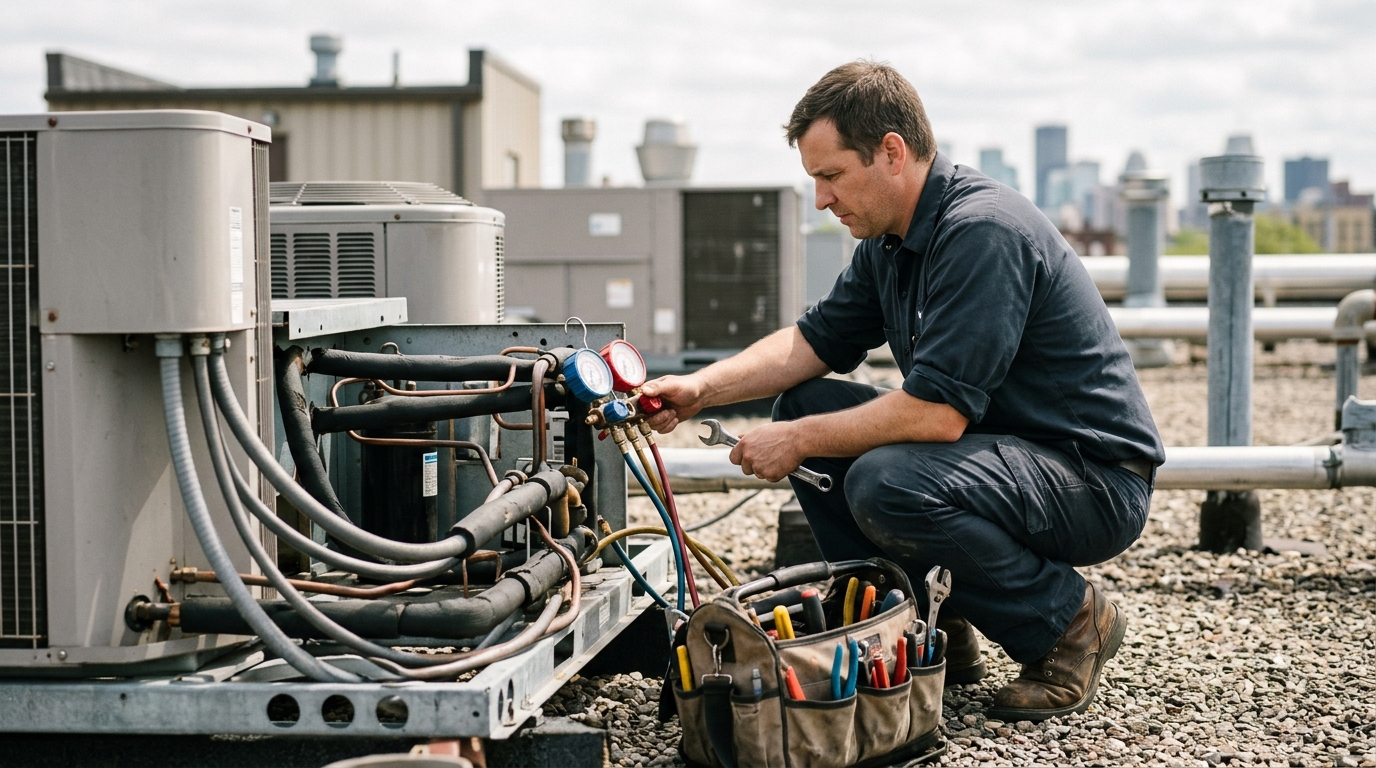
To become an HVAC technician you usually complete a postsecondary certificate or associate's program in heating, air conditioning and refrigeration, pass the EPA refrigerant handling exam, and then learn the job properly on a truck beside an experienced technician. The U.S. Bureau of Labor Statistics (2025) says technicians typically need a postsecondary nondegree award, though some enter with less education, and that a lengthy period of on-the-job training follows hiring.
The other common route is a paid apprenticeship, which usually lasts several years and mixes full-time work with classroom instruction each year (U.S. Bureau of Labor Statistics, 2025). Either way, expect to be useful within months and genuinely competent in years.
What an HVAC Technician does
An HVAC technician installs, maintains and repairs heating, ventilation, air conditioning and refrigeration systems. The U.S. Bureau of Labor Statistics (2025) lists the core duties, and a typical day pulls several of them together.
- Install HVACR equipment and the electrical components and wiring that run it, following the manufacturer's instructions and the job's drawings.
- Inspect and test systems and components — checking refrigerant charge, airflow, electrical circuits and safety controls — to find out why a unit is short-cycling, freezing up or blowing warm.
- Repair or replace worn or defective parts: capacitors, contactors, blower motors, igniters, compressors, thermostats.
- Discuss system malfunctions with customers, explain what failed, and lay out repair versus replacement options in plain language.
- Recommend maintenance that improves system performance, such as coil cleaning, filter schedules or duct repairs.
- Keep records of work performed, including refrigerant added or recovered, parts used and warranty details.
- Perform seasonal maintenance visits — furnace tune-ups in autumn, condenser cleanings in spring — which fill a large share of the calendar for residential companies.
Where you work. Heating, air conditioning and refrigeration mechanics and installers held about 440,900 jobs in 2025, and the largest employer group by far was plumbing, heating and air-conditioning contractors, at 68 percent (U.S. Bureau of Labor Statistics, 2025). You install and repair systems in homes, schools, hospitals and other buildings, which means attics in July, crawl spaces, rooftops and mechanical rooms. Expect cramped spaces, outdoor work and extreme temperatures (U.S. Bureau of Labor Statistics, 2025). Some technicians stay residential; others move into commercial rooftop units, chillers, supermarket refrigeration or building controls.
Typical schedule. Most technicians work full time, and schedules may vary to include evening or weekend shifts. You may be on call for emergencies, and overtime or irregular hours are common during peak heating and cooling seasons (U.S. Bureau of Labor Statistics, 2025).
The honest downside. The work is physically hard and seasonally lopsided. A heat wave or a cold snap means twelve-hour days and no-heat calls at 10pm; shoulder seasons can be slow at companies that don't sell maintenance agreements. You will be dirty, you will carry equipment up stairs, and you will meet customers who are angry about a bill you didn't write. Knees, shoulders and backs take the wear, which is part of why many technicians aim for lead, estimating or management roles later.
How to become one
- Take the right high school or adult-education courses. Vocational education, math and physics are the recommended starting subjects for students interested in this work (U.S. Bureau of Labor Statistics, 2025). Allow one to two years alongside other classes; public school costs nothing, and a GED program through an adult school is the equivalent route if you left early. Shop classes that include basic electrical wiring are the most directly useful.
- Choose between a trade program and an apprenticeship. Postsecondary instruction in heating, air conditioning and refrigeration from technical and trade schools or community colleges generally lasts 6 months to 2 years and leads to a certificate or an associate's degree (U.S. Bureau of Labor Statistics, 2025). An apprenticeship usually lasts several years and includes paid on-the-job training plus technical instruction each year covering safety practices, blueprint reading, and heating and cooling systems (U.S. Bureau of Labor Statistics, 2025). Spend two to four weeks on this decision: call the admissions office at your nearest community college and the training coordinator at a local contractor or trade association, and ask both what their graduates are doing a year later.
- Enrol and complete the program. Budget 6 months for a focused certificate or up to 2 years for an associate's degree. Tuition varies widely by state and by whether you are an in-district resident at a community college or a student at a private trade school — ask the registrar for the current per-credit rate and the total program cost in writing, so you are comparing [$X] against [$X] and not brochures. Also ask what tools you must buy; a basic kit of a manifold gauge set, a clamp meter, nut drivers and a tubing cutter is a standard first purchase.
- Pass the EPA Section 608 certification exam. Nearly all HVAC technicians are required by the U.S. Environmental Protection Agency to be certified in proper refrigerant handling, and certification requires passing an exam that is typically included as part of completing a postsecondary HVACR program (U.S. Bureau of Labor Statistics, 2025). Section 608 of the Clean Air Act covers technicians who maintain, service, repair or dispose of equipment that could release refrigerants (EPA, via ESCO Group). Allow two to six weeks of study; aim for Universal certification rather than a single type so you are not locked out of small appliances or high-pressure systems. Exam and proctoring fees are set by the certifying organisation — confirm the current fee before you book.
- Get a driver's licence and keep the record clean. Technicians may need a driver's licence to travel to jobsites (U.S. Bureau of Labor Statistics, 2025). If you don't have one, start now, because insurance rules at service companies can rule out applicants with recent violations. Time depends on your state's testing process; costs are the state's licence and testing fees.
- Apply for a helper, installer or apprentice job. Plumbing, heating and air-conditioning contractors employ most technicians (U.S. Bureau of Labor Statistics, 2025), so start there. Allow four to twelve weeks of applying. Ask for the service manager by name rather than only submitting online forms, and bring your 608 card to the interview. Newly hired technicians typically work alongside experienced technicians, starting with basic tasks such as insulating refrigerant lines or cleaning furnaces, then moving on to harder work like cutting and soldering pipes or checking electrical circuits (U.S. Bureau of Labor Statistics, 2025).
- Check whether your state or locality requires a licence. Some states and localities require HVAC technicians to be licensed, and information on state licensing board requirements is available from CareerOneStop (U.S. Bureau of Labor Statistics, 2025). Do this before you move or take a job across a state line, because experience-hour requirements differ. Allow a day to research and months to years to accumulate any required hours.
- Add a manufacturer or industry certification once you have time on the tools. Manufacturer and industry certifications are available; many are optional, although some employers prefer or require specific types, and CareerOneStop lists them (U.S. Bureau of Labor Statistics, 2025). North American Technician Excellence (NATE) is an independent organisation that certifies installation or service technicians (Lennox). Plan on one to two years of field experience first, then a few weeks of exam prep; many employers pay the fee or reimburse a pass.
Skills you'll need
Hard skills
- Refrigeration diagnostics with gauges and probes. Reading superheat and subcooling from a manifold gauge set or wireless probes, pulling a vacuum to a target reading on a micron gauge, and recovering refrigerant legally with a recovery machine and cylinder. This is the skill that separates a parts-changer from a technician.
- Electrical troubleshooting. Using a multimeter and clamp meter to check voltage, continuity, amp draw and capacitor microfarads, and reading a ladder diagram to trace a control circuit. HVAC technicians install electrical components and wiring as part of the job (U.S. Bureau of Labor Statistics, 2025).
- Tubing and brazing work. Cutting, swaging, flaring and brazing copper line sets with a torch and nitrogen purge, then pressure testing for leaks. Apprentices typically progress into cutting and soldering pipes after basic tasks (U.S. Bureau of Labor Statistics, 2025).
- Combustion and airflow measurement. Running a combustion analyzer on a furnace, checking static pressure with a manometer, and knowing what a bad reading means for safety and for the customer's comfort complaint.
- Blueprint reading and basic load math. Apprenticeship instruction covers blueprint reading (U.S. Bureau of Labor Statistics, 2025), and math skills are listed among the important qualities for the occupation (U.S. Bureau of Labor Statistics, 2025) — you will size equipment, calculate duct runs and convert units daily.
- Service software and connected equipment. Technology skills matter (U.S. Bureau of Labor Statistics, 2025): dispatch and invoicing apps on a tablet, manufacturer fault-code apps, communicating thermostats and basic building controls.
Soft skills and how to show them
- Customer service. You discuss system malfunctions with customers and recommend maintenance (U.S. Bureau of Labor Statistics, 2025). Show it in an interview by explaining a technical fault the way you would to a homeowner, without jargon and without scaring them into a sale.
- Problem-solving. Show it by describing one fault you chased to its root cause and how you ruled options out in order, rather than listing parts you replaced.
- Detail orientation. Show it through your records: technicians keep records of work performed (U.S. Bureau of Labor Statistics, 2025), so bring a sample service ticket or photos of a tidy line set and labelled wiring.
- Physical stamina and strength. Both are listed as important qualities (U.S. Bureau of Labor Statistics, 2025). Show it honestly — mention attic and rooftop work you have done, and ask about typical lifting and ladder requirements rather than discovering them on day two.
- Reliability under pressure. On-call and peak-season overtime are normal (U.S. Bureau of Labor Statistics, 2025). Show it with an example of a week you worked long hours and how you kept the quality of the last call equal to the first.
Pay and outlook
Pay in this trade is not one number, and anyone who quotes you one is guessing. It is driven by the region and metro you work in, whether the employer is residential or commercial, whether the shop is union or non-union, and whether you are paid hourly, hourly plus overtime, or on a flat-rate or commission structure where part of your earnings follow the work you sell and complete. Overtime and on-call pay matter more here than in most occupations, because schedules commonly include evenings, weekends and irregular hours during peak heating and cooling seasons (U.S. Bureau of Labor Statistics, 2025).
The things you control are credentials and specialisation. EPA refrigerant certification is effectively mandatory, since nearly all technicians must be certified in proper refrigerant handling (U.S. Bureau of Labor Statistics, 2025), so it is a floor rather than an advantage. What moves you up is the harder work: commercial refrigeration, chillers, controls and building automation, and hydronics, plus a state or local licence where one is required. Some employers prefer or require specific manufacturer or industry certifications (U.S. Bureau of Labor Statistics, 2025), and holding one — NATE, for example, which certifies installation or service technicians (Lennox) — can be the difference between two otherwise similar applicants.
Demand looks solid. Employment of heating, air conditioning and refrigeration mechanics and installers is projected to grow 11 percent from 2025 to 2035, much faster than the average for all occupations, with about 40,600 openings projected each year on average (U.S. Bureau of Labor Statistics, 2025). Many of those openings are expected to come from the need to replace workers who move to other occupations or leave the labour force, including retirements (U.S. Bureau of Labor Statistics, 2025). That replacement pattern is why apprenticeships and helper roles keep opening even in slow building years: buildings that already exist still need their equipment serviced.
For current pay, check the U.S. Bureau of Labor Statistics Occupational Outlook Handbook entry for heating, air conditioning, and refrigeration mechanics and installers, and the Bureau's Occupational Employment and Wage Statistics data, which break figures down by state and metropolitan area — the state-level spread is wide. For licensing requirements by state, CareerOneStop lists state licensing board requirements (U.S. Bureau of Labor Statistics, 2025). For a local reality check, ask two or three service managers in your area what their apprentice, mid-level and lead technician ranges look like and what the on-call rotation pays.
Career path
Titles vary by employer, and a small residential shop may have three levels where a large mechanical contractor has seven. The progression below is the common shape.
| Stage | Typical titles | Usual time at this stage |
|---|---|---|
| Entry | Helper, installer's apprentice, maintenance technician | 1-3 years |
| Developing | Service technician, installation technician, apprentice in years 2-4 of a program | 2-5 years |
| Senior | Lead technician, commercial or refrigeration technician, controls technician | 5+ years |
| Beyond the truck | Service manager, estimator, field supervisor, instructor, business owner | 8+ years in |
Entry (roughly years 0-3). You start as a helper or install apprentice. Newly hired technicians typically work alongside experienced technicians, beginning with basic tasks such as insulating refrigerant lines or cleaning furnaces, then taking on more difficult tasks such as cutting and soldering pipes or checking electrical circuits (U.S. Bureau of Labor Statistics, 2025). If you are in a formal apprenticeship, this period is paid on-the-job training with technical instruction each year, and it usually runs several years (U.S. Bureau of Labor Statistics, 2025). Expect a lengthy period of on-the-job training before you are considered competent (U.S. Bureau of Labor Statistics, 2025).
Developing (roughly years 2-6). You run your own truck and your own calls. Maintenance visits and straightforward residential repairs come first; diagnostics on intermittent faults and commercial equipment come later. This is the stage where a state or local licence, if your jurisdiction requires one, usually becomes reachable, and where industry certification starts to pay off.
Senior (roughly years 5-12). Lead technician, or a specialist title in commercial refrigeration, chillers or controls. You take the calls other technicians could not solve, train apprentices, and are often the person a service manager calls at midnight. Specialising here has the biggest effect on earnings and on how long your body lasts.
Beyond the truck (typically 8+ years in). Service manager, dispatcher, estimator, project manager, sales, trade-school instructor, or owning a contracting business. Many technicians move this way in their forties, partly by choice and partly because attic and rooftop work in extreme temperatures (U.S. Bureau of Labor Statistics, 2025) does not get easier. Build toward it early: keep clean records, learn to quote work accurately, and get comfortable explaining costs to customers.
Frequently asked questions
Do I need a college degree to become an HVAC technician?
No. HVAC technicians typically need a postsecondary nondegree award, and some enter the occupation with less education (U.S. Bureau of Labor Statistics, 2025). A certificate from a technical school or community college, or an apprenticeship, is the normal path. An associate's degree is one option within that range of postsecondary programs, which generally last from 6 months to 2 years (U.S. Bureau of Labor Statistics, 2025), but it is not a requirement for entry.
How long does it take to get a first HVAC job?
It depends on your route. A short certificate program can be completed in about 6 months, with longer programs running up to 2 years (U.S. Bureau of Labor Statistics, 2025), and many students apply for helper or installer work before they finish. An apprenticeship puts you to work immediately but usually lasts several years to complete (U.S. Bureau of Labor Statistics, 2025). After hiring, expect a lengthy period of on-the-job training before you are working unsupervised (U.S. Bureau of Labor Statistics, 2025).
Can any of this work be done remotely?
The technician job itself cannot be. You install and repair systems in homes, schools, hospitals and other buildings, sometimes in cramped spaces, outdoors or in extreme temperatures (U.S. Bureau of Labor Statistics, 2025), and you may need a driver's licence to travel to jobsites (U.S. Bureau of Labor Statistics, 2025). Some classroom instruction can be taken online, but hands-on labs and the EPA certification exam are in person. Later-career roles in dispatch, estimating, technical support or building-controls monitoring involve more desk work, and those are the closest thing to remote in this field.
Is EPA certification actually required, or is it optional?
It is effectively required. Nearly all HVAC technicians must be certified by the U.S. Environmental Protection Agency in proper refrigerant handling, and that certification requires passing an exam, typically included as part of completing a postsecondary HVACR program (U.S. Bureau of Labor Statistics, 2025). Section 608 of the Clean Air Act applies to technicians who maintain, service, repair or dispose of equipment that could release refrigerants into the atmosphere (EPA, via ESCO Group). Other certifications differ: many manufacturer and industry certifications are optional, though some employers prefer or require specific types (U.S. Bureau of Labor Statistics, 2025).
Do I need a licence, and does it transfer between states?
Some states and localities require HVAC technicians to be licensed, and requirements differ from one jurisdiction to the next — CareerOneStop publishes state licensing board requirements (U.S. Bureau of Labor Statistics, 2025). Check the board in the state and city where you intend to work before you enrol in a program or accept a job, because experience-hour and exam rules are set locally and a licence is not automatically recognised elsewhere.
Sources
- U.S. Bureau of Labor Statistics — Heating, Air Conditioning, and Refrigeration Mechanics and Installers : Occupational Outlook Handbook (2025)
- EPA (via ESCO Group) — EPA Section 608 Certification

Written by
Marisol Andrade
Marisol steers Jobguidedaily's coverage of career pivots and the messy middle of working life. She's drawn to the moment someone realizes their job title no longer fits who they are, and what they do next.